
Irritable bowel syndrome (IBS) and inflammatory bowel disease (IBD) rank among the most frequently confused diagnoses in gastroenterology. The abbreviations differ by a single letter. Several symptoms overlap. Both involve the gastrointestinal tract, and both can substantially affect daily life. The differences between IBS and IBD, however, carry significant implications for treatment, long-term outlook, and the underlying disease process. Confusing the two leads to patients either under-treating genuine inflammation or over-treating a functional disorder. The information below outlines the practical distinctions.
The Core Difference
IBS is a functional disorder. IBD is an autoimmune disease. That distinction is the framework for everything that follows.
In IBS, or irritable bowel syndrome, the gastrointestinal tract does not function properly, though the tissue itself appears structurally normal on endoscopic examination. The nerves and smooth muscle of the intestine misfire, motility is altered, and symptoms result. In IBD, or inflammatory bowel disease, the immune system attacks the intestinal lining, producing measurable inflammation, ulceration, and visible tissue damage. Crohn’s disease and ulcerative colitis are the two principal forms of IBD.
IBS represents a functional issue. IBD represents a structural one.

Overlapping Symptoms
Several symptoms occur in both conditions, which is why the two are sometimes confused at the level of initial primary care evaluation:
- Abdominal pain and cramping
- Diarrhea or constipation, sometimes alternating
- Bloating and excess gas
- Urgency, defined as a sudden need to find a bathroom
- Fatigue
A patient presenting with cramping and diarrhea could initially fit either pattern. The overlap is precisely why structured testing is required rather than empirical management.
Symptoms That Point to IBD
Several symptoms rarely occur with IBS and should prompt immediate evaluation for inflammatory bowel disease:
- Blood in the stool or rectal bleeding
- Unintended and often substantial weight loss
- Fever during symptom flares
- Anemia identified on blood work
- Nighttime abdominal pain or diarrhea that disrupts sleep
- Mouth sores, joint pain, eye inflammation, or skin rashes
IBD is a systemic autoimmune condition, and extra-intestinal manifestations are common. When any of the symptoms above are present, attribution to IBS without further evaluation is inappropriate.
How IBS Is Diagnosed
IBS is a clinical diagnosis, established by symptom pattern combined with the exclusion of other conditions. No single blood test or imaging study confirms it. Gastroenterologists apply the Rome IV criteria, which evaluates the duration and pattern of symptoms, and typically order tests to rule out celiac disease, thyroid dysfunction, infection, and IBD before arriving at an IBS diagnosis.
A colonoscopy in a patient with IBS will typically appear entirely normal. That finding is not a failed diagnostic test; it is a meaningful result. Normal-appearing tissue in a patient with persistent symptoms supports a functional disorder rather than structural disease.
IBS is classified into three principal subtypes: IBS-D, diarrhea predominant; IBS-C, constipation predominant; and IBS-M, mixed. The subtype determines treatment selection, which is why accurate classification matters.
How IBD Is Diagnosed
IBD diagnosis requires direct visualization of the intestinal lining, generally by colonoscopy and, in some cases, upper endoscopy. The gastroenterologist obtains biopsies, which a pathologist examines for the characteristic inflammatory pattern.
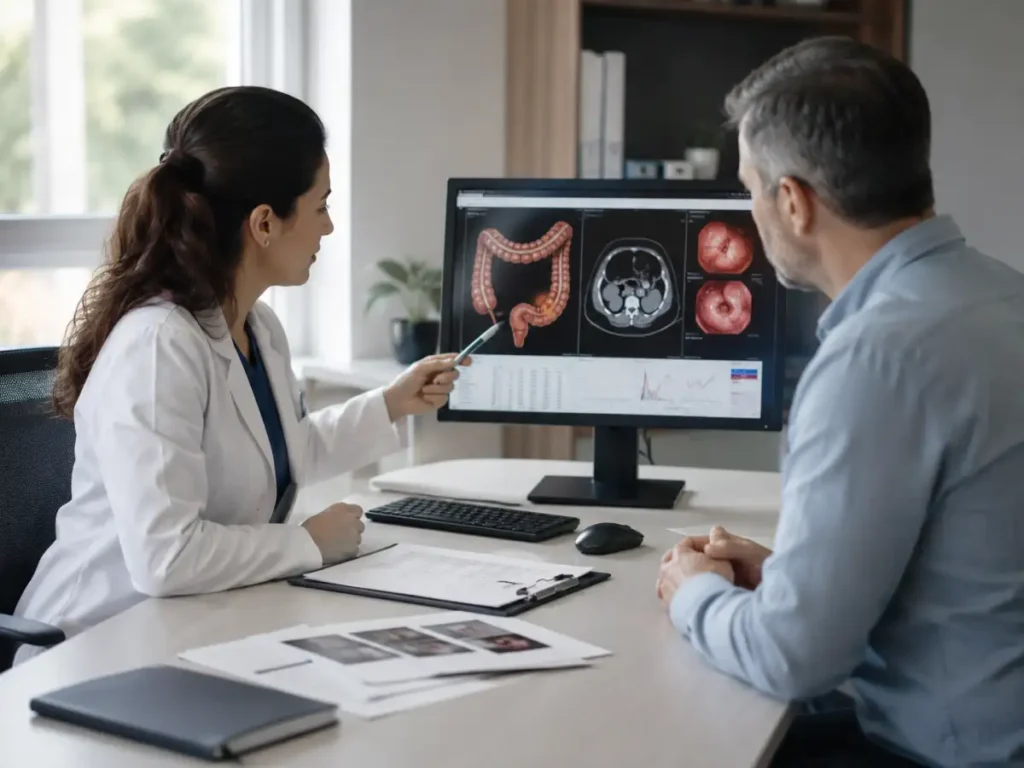
Additional studies routinely used in IBD evaluation include:
- Blood markers of inflammation, including C-reactive protein and ESR
- Fecal calprotectin, a stool test that reliably distinguishes inflammation from a functional disorder
- Cross-sectional imaging such as CT enterography or MR enterography to evaluate the small intestine
- Capsule endoscopy in selected cases, in which a pill-sized camera is swallowed
Fecal calprotectin warrants particular emphasis. A normal calprotectin level makes IBD highly unlikely. An elevated calprotectin level provides strong evidence of inflammation and typically prompts colonoscopy.
How Treatment Differs
This is the point at which an accurate diagnosis materially changes patient outcomes.
IBS Treatment Targets Symptom Control
IBS treatment is built on dietary modification, stress management, and targeted pharmacotherapy. The low FODMAP diet provides meaningful improvement for a substantial percentage of IBS patients, and the Gastro Health & Nutrition dietitians guide patients through the elimination and reintroduction phases. Antispasmodics, low-dose antidepressants for nerve-gut signaling modulation, and newer agents such as rifaximin or linaclotide are matched to specific subtypes.
IBS is not curable in the traditional sense, though most patients achieve a level of symptom control that allows daily life to feel normal. Some trial and adjustment is typically required.
IBD Treatment Targets the Immune Response
IBD is a serious disease that requires medication to suppress or modulate the immune response. Treatment is stepwise. It begins with anti-inflammatories such as mesalamine for mild ulcerative colitis and progresses to immunomodulators and biologic agents, including adalimumab, infliximab, vedolizumab, ustekinumab, and newer options, for moderate to severe disease.
The treatment goal in modern IBD care is mucosal healing, meaning resolution of inflammation and healing of the intestinal lining, rather than symptom suppression alone. Untreated or undertreated IBD can lead to strictures, fistulas, surgical intervention, and, in ulcerative colitis, an elevated risk of colorectal cancer.
Long-Term Outlook
IBS is a chronic condition that does not produce permanent intestinal damage. It does not increase colon cancer risk, does not lead to surgery, and does not reduce life expectancy. It can affect quality of life substantially, though the condition itself is not dangerous.
IBD is chronic and progressive in the absence of treatment. Approximately 70 percent of patients with Crohn’s disease will require surgery at some point. Ulcerative colitis is associated with an increased risk of colorectal cancer over time, which is the basis for surveillance colonoscopy. Treatment outcomes have improved substantially over the past 15 years, and most patients on contemporary therapy live full, active lives with well-controlled disease.
Why Misdiagnosis Carries Clinical Cost
A common pattern presents as follows. A patient is told they have IBS for five or ten years, manages symptoms with dietary changes and over-the-counter medication, and eventually reaches a gastroenterology office with anemia, weight loss, or a stricture. The underlying diagnosis was IBD throughout. Inflammation that was untreated for years caused damage that earlier intervention would have prevented.
The reverse pattern also occurs. Patients convinced of an IBD diagnosis based on a relative’s history request biologic therapy when their bowel actually appears normal and the appropriate management is dietary modification and stress reduction. Accurate diagnosis protects patients from both undertreatment and overtreatment.
When to See a Gastroenterologist
Self-diagnosis of IBS or IBD is not appropriate. A gastroenterology appointment is warranted in the presence of any of the following:
- Persistent abdominal pain, diarrhea, or constipation lasting more than a few weeks
- Any blood in the stool, at any time
- Unintended weight loss accompanying digestive symptoms
- A family history of IBD, celiac disease, or colon cancer
- Symptoms that disrupt sleep
- An existing IBS diagnosis that is not improving with treatment
Schedule an Appointment at Gastro Health & Nutrition
Board-certified gastroenterologists at Gastro Health & Nutrition treat both IBS and IBD patients across Cypress, Katy, Sugar Land, Portland, and Victoria. Dr. Diana Franco Corso is board-certified in Gastroenterology and completed an advanced fellowship in inflammatory bowel diseases at the Cleveland Clinic. The clinical team also includes dietitians who guide patients through low FODMAP protocols for IBS management.
Patients whose digestive symptoms have not been formally evaluated, and patients whose current treatment is not producing improvement, can request an appointment at yourgastrohealth.com or call the nearest office. An accurate diagnosis is the first step toward effective treatment.
Frequently Asked Questions
What is the main difference between IBS and IBD?
IBS is a functional disorder in which the gut does not function properly though the tissue appears normal. IBD is an autoimmune disease that causes measurable inflammation, ulceration, and visible damage to the intestinal lining.
Can IBS turn into IBD?
No. IBS does not progress to IBD. They are distinct conditions with different causes. Patients diagnosed with IBS whose symptoms change or worsen should be reevaluated to confirm the original diagnosis remains accurate.
How are IBS and IBD diagnosed differently?
IBS is diagnosed based on symptom patterns using the Rome IV criteria along with exclusion of other conditions. IBD requires colonoscopy with biopsies to identify inflammation, supplemented by blood work and stool tests such as fecal calprotectin.
Is IBD dangerous if left untreated?
Yes. Untreated IBD can lead to strictures, fistulas, anemia, and, in ulcerative colitis, an increased risk of colorectal cancer. Approximately 70 percent of patients with Crohn’s disease eventually require surgery without effective treatment.
Does the low FODMAP diet help IBD?
The low FODMAP diet is most effective for IBS. It can help some IBD patients manage symptoms during remission, though it does not treat the underlying inflammation in IBD. Medication remains the foundation of IBD treatment.
When should a patient see a gastroenterologist for IBS or IBD symptoms?
Evaluation is appropriate for digestive symptoms persisting more than a few weeks, any blood in the stool, unintended weight loss, or an existing IBS diagnosis that is not improving with treatment.